Imagine, if you will, having nearly perfect color vision, but when you close your eyes, whether to dream or to simply imagine, all you see in your mind's eye is black and white and shades of gray. That bright red fire engine? It becomes a black truck, its beautiful gold leaf lettering turning to shades of gray.
Welcome to my world.
I do photograph in color, but for me, the colors must make a statement of their own, such as with fall foliage.
But black and white is my jam.
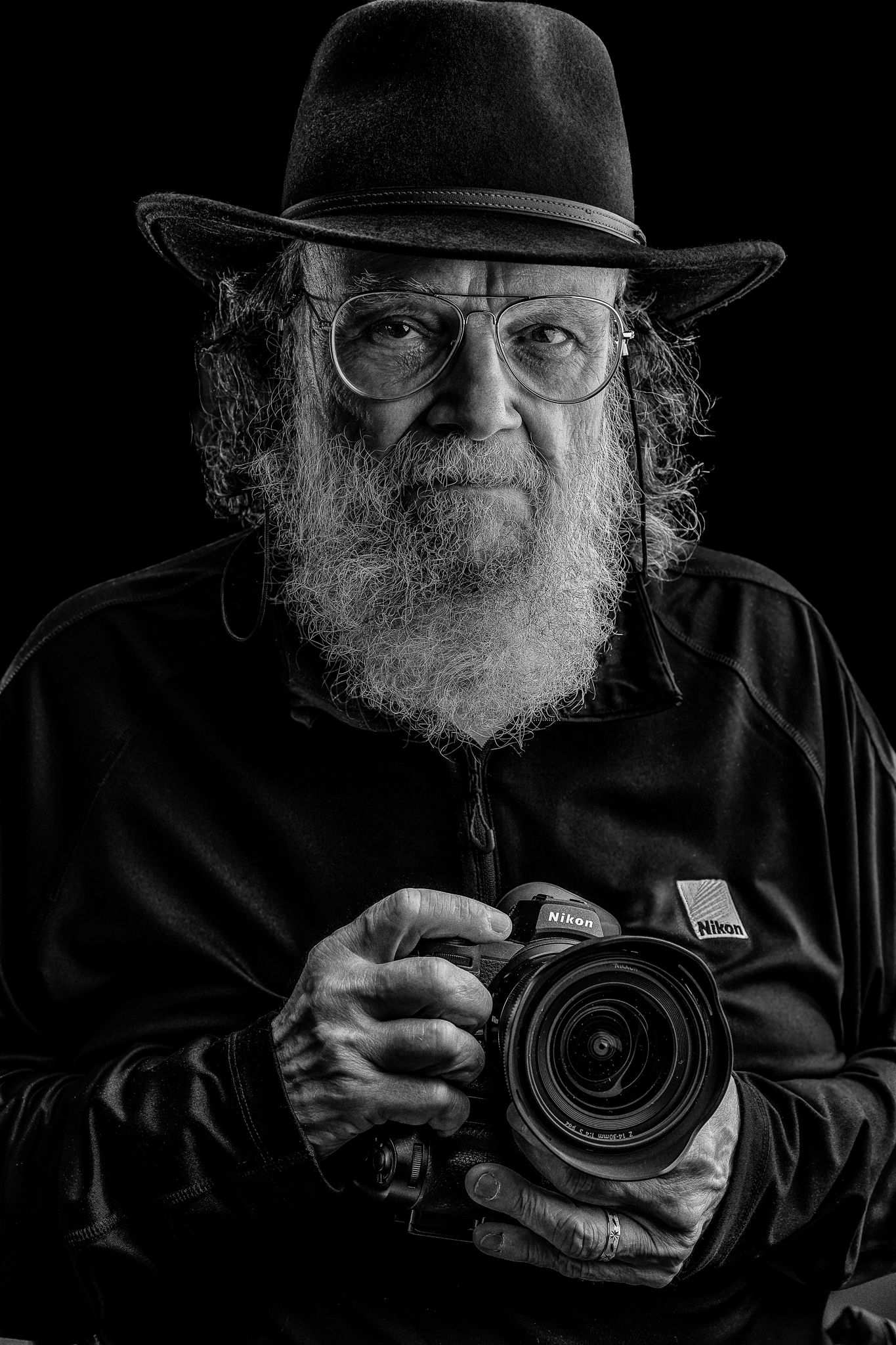
Who Am I?
Ansel Adams, arguably the greatest landscape photographer, said, “The negative is the score, and the print the performance,” and “You don’t take a photograph, you make it.”
I don’t worry about the time of day or the position of the sun in the sky. I’m not concerned with how tall the mountains are, or how the fog rolls off the water. The gleam of the buildings or their state of decay matters not. I focus instead on the language of black and white photography — light and shadow, form, and texture. Most of the time, the photo is already there, just waiting to be discovered.
As Henry David Thoreau once wrote, "The question is not what you look at, but what you see.”
Sometimes I will see something that might seem at first glance to be rather mundane, but I imagine a finished image that, with some effort, might make a rather interesting photo.
My photo, “Field Bros,” came about this way. When I saw this wonderful example of Streamline Art Deco architecture in Pauls Valley, I knew that even though it was nothing more than an old gas station, with a little work, it could make a special a photo.
“The Edge of Forever” came about quite differently. I almost literally stumbled upon the puddle. The scooter was already parked right there. It was simply a matter of seeing the relationship of the elements, and focusing on the right thing (the reflection). Everything else fell into place.
My goal is to invite the viewer into my images, to think and feel about the subjects and environments in new ways. To “hear” a performance they haven’t experienced before. Not simply to look, but to “see” more deeply than they might have otherwise.